Selasa, 10 Juni 2014

pengertian & fungsi adverb and adjective

Pengertian Adverbs

Adverbs adalah kata keterangan. Adverbs dan adjectives memiliki kesamaan. Jika ditinjau dari segi filsafat bahasa, kedua kata ini diawali dengan kata “Ad” yang memungkinkan adanya arti “Add” atau “penambahan”. Jika adjectives menambahkan kejelasan arti pada benda-benda (nouns), maka adverbs menambahkan kejelasan terhadap kata kerja (verbs), misalnya:

“She runs slowly” (Dia berlari dengan lambat). Kata “slowly” merupakan adverb yang menjelaskan atau menambah kejelasan pada makna “runs” (bagaimana dia berlari), bukannya “she”. Meskipun yang berlari (“runs”) adalah subject “she”, namun adverb dari kata “slowly” menjelaskan kata kerjanya (“runs”). Sehingga memberi makna jelas bahwa “berlari-nya dilakukan dengan lambat/ perlahan” (runs slowly).

Jadi, adverbs itu adalah kata keterangan yang memberi penjelasan pada semua kata lain kecuali kata benda. Pada umumnya adverbs dapat dibentuk dari adjectives dengan menambahkan kata “-ly” di belakang kata sifat tersebut. Namun, peraturan ini tidak berlaku untuk semua kata sifat. Silahkan perhatikan contoh di bawah ini.

Contoh Adverbs (Kata Keterangan)

Adjectives
Adverbs
Fluent
Contoh kalimat:
Her English is fluent.
(Artinya: Bahasa Inggris dia fasih/ lancar)
Fluently
Contoh kalimat:
She can speak English fluently.
(Artinya: Dia dapat berbicara Bahasa Inggris dengan fasih/ lancar)
Slow
Contoh kalimat:
He is a slow reader.
(Artinya: Dia adalah pembaca yang lambat)
Slowly
Contoh kalimat:
He reads the book slowly.
(Artinya: Dia membaca buku dengan lambat)
Quick
Contoh kalimat:
She is quick writer.
(Artinya: Dia adalah penulis yang cepat)
Quickly
Contoh kalimat:
She writes quickly.
(Artinya: Dia menulis dengan cepat)

CATATAN:
Aturan membentuk adverbs tidak selalu harus menambahkan akhiran “-ly” dari semua kata sifat (adjectives). Aturan ini hanya berlaku untuk beberapa kata sifat saja.

Fungsi Adverbs (Kata Keterangan)

Selain digunakan untuk menerangkan kata kerja (verbs), terkadang adverbs juga digunakan untuk memodifikasi atau menerangkan adjectives (kata sifat), misalnya:

I am extremely happy. (Artinya: Saya sangat bahagia)
Pada contoh kalimat di atas, kata “extremely” berfungsi sebagai adverb yang menerangkan kata sifat “happy”.

Adverbs juga digunakan untuk mengekspresikan waktu atau frekwensi, contohnya: tomorrow, today, yesterday, soon, never, usually, always, yet, etc. Untuk informasi selengkapnya mengenai adverbs (kata keterangan), kami sarankan silahkan baca juga artikel kami mengenai Pengertian dan Macam-macam Adverb Clauses.

Contoh Kalimat Menggunakan Adverbs (Kata Keterangan)

George writes carelessly.
I answered that his question easily.
Sally speaks softly.
I entered the classroom quietly because I was late.
Jack opened the heavy door slowly.
The old man carves wooden figures skillfully.
A busy executive usually has short conversations on the telephone.
The young man had a very good time at the picnic yesterday.
I write English articles continuously.
She has been singing a song beautifully for 6 minutes.

Pengertian Adjective Clause

Adjective clause atau relative clause adalah dependent clause yang berfungsi sebagai adjective dan menjelaskan tentang noun atau pronoun pada main clause dari suatu complex sentence (kalimat yang terdiri dari independent clause dan satu atau lebih dependent clause).
Posisi adjective clause selalu mengikuti noun atau pronoun yang diterangkannya. Di dalam kalimat, noun atau pronoun itu berfungsi sebagai subject atau object. Adjective clause dimulai dengan suatu kata yang disebut relative pronoun (who, whom, that, which, whose, etc) yang berfungsi menjembatani hubungan dengan noun atau pronoun yang diterangkannya.

Contoh Adjective Clause pada Complex Sentence:

Simple SentenceComplex SentenceKeterangan
The book is interesting.The book that he has read is interesting.The book: noun (phrase), that: relative pronoun, that he has read: adjective clause yang menjelaskan the book. Merupakan klausa karena terdiri dari subject (he) dan verb (has read) dan merupakan adjective clause karena menjelaskan noun.

Rumus Adjective Clause

adjective clauseComplex Sentence:

Independent Clause + Adjective Clause

Adjective Clause:

Relative Pronoun +/- S*+V
Keterangan: *Relative pronoun (who, which, that) dapat berfungsi sebagai subject jika tidak ada subject.

Fungsi Relative Pronoun pada Adjective Clause

Beberapa fungsi relative pronoun di dalam adjective clause berikut contohnya adalah sebagai berikut.
FungsiRelative PronounContoh Adjective ClausePembuktian
Subjectwho, that, whichthat was made of cheddar cheese.coba substitusi dengan “It” (subjective personal pronoun)
Object*whom, that, which, whowhom I want to buycoba substitusi dengan “it” (objective personal pronoun)
Possessivewhosewhose house has burned downcoba substitusi dengan “his” (possessive personal pronoun)
*Dapat dihilangkan pada defining relative clause.

Punctuation (Tanda Baca) pada Adjective Clause

Saat menerangkan subject, posisi adjective clause akan berada di tengah kalimat. Klausa tersebut dapat diapit koma ataupun tidak, tergantung pada penting atau tidaknya informasi tambahan yang dibawanya. Informasi tersebut dinilai essential (penting) atau restrictive jika akan mengubah makna kalimat jika dihilangkan. Pada situasi tersebut, koma tidak digunakan. Klausa yang membawa informasi essential tersebut dinamakan defining clause. Sebaliknya, jika informasi non-essential (tidak penting) atau non-restrictive karena dapat dihilangkan tanpa merubah makna kalimat, maka koma digunakan. Klausa yang membawa informasi non-essential tersebut dinamakan non-defining clause.

Contoh Complex Sentence:

  • Essential: People who chew well may have healthy digestion.
  • Non-essential: Yulia, who works out three times a week, has a positive body image.

Contoh Kalimat Adjective Clause

Beberapa contoh kalimat adjective clause dengan berbagai relative pronoun dapat dilihat pada tabel sebagai berikut.
Relative PronounContoh Kalimat Adjective ClauseKeterangan
whoHe is the man who works hard to support their daily needs. (Dia pria yang bekerja keras untuk menanggung kebutuhan sehari-hari mereka.)Adjective clause  menerangkan noun (the man) yang berfungsi sebagai subject complement.
whomThe woman whom you saw last night is my sister. (Wanita yang kamu lihat tadi malam adalah saudara saya.)Adjective clause menerangkan noun (the woman) yang berfungsi sebagai subject kalimat.
whoseThe man, whose car is antique, works as a lecturer. (The man yang punya mobil antik itu bekerja sebagai dosen.)Adjective clause menerangkan noun (the man) yang berfungsi sebagai subject kalimat.
whichMueeza, which is very faithful, is my cat. (Mueeza, yang sangat setia, adalah kucing saya.)Adjective clause menerangkan noun (Mueeza) yang berfungsi sebagai subject kalimat.
where (relative adverb)Bandar Lampung is a city where I was born. (Bandar Lampung adalah kota dimana saya dilahirkan.)Adjective clause menerangkan noun (a city) yang berfungsi sebagai subject complement.
thatIt is the car that I have dreamed for many years ago. (Ini mobil yang telah saya impikan sejak beberapa tahun yang lalu.)Adjective clause menerangkan noun (the car) yang berfungsi sebagai subject complement.

Minggu, 04 Mei 2014


Rumus Umum : TO BE + V3
1.       Simple Present Tense
Aktif : S + do/does + not + V1
Pasif : S + to be (am, are, is) + not + V3 + by + O
Contoh:
Aktif : She doesn't write the book
Pasif : The book isn't written by her
Aktif : I don't wash the car
Pasif : The car isn't washed by me
2.       Present Continuous Tense
Aktif : S + to be (am, are, is) +  not + V1-ing
Pasif : S + to be (am, are, is) + not + being + V3 + by + O
Contoh :
Aktif : She isn't reading the book
Pasif : The book isn't being read by her
3.       Present Perfect Tense
Aktif : S + have/has + not + V3 + O
Pasif : S + have/has + not + been + V3 + by + O
Contoh :
Aktif : She hasn't written the book
Pasif : The book hasn't been written by her
Aktif : I haven't written the book
Pasif : The book hasn't been written by me
4.       Present Perfect Continuous Tense
Aktif : S + have/has + not + been + V1-ing + O
Pasif : S + have/has + not + been + being + V3 + by + O
Contoh :
Aktif : She hasn't been reading the book
Pasif : The book hasn't been being read by her
Aktif : I haven't been washing the car
Pasif : The car hasn't been being washed by me
5.       Simple Past Tense
Aktif : S + did + not + V1
Pasif : S + to be (was, were) + not + V3 + by + O
Contoh :
Aktif : She didn't write a letter
Pasif : A letter wasn't written by her
6.       Past Continuous Tense
Aktif : S + to be (was, were) + not + V1-ing + O
Pasif : S + to be (was, were) + not + being + V3 + by + O
Contoh :
Aktif : She wasn't washing the car
Pasif : The car wasn't being washed by her
7.       Past Perfect Tense
Aktif : S + had + not + V3 + O
Pasif : S + had + not + been + V3 + by + O
Contoh :
Aktif : She hadn't washed the car
Pasif : The car hadn't been washed by her
8.       Past Perfect Continuous Tense
Aktif : S + had + not + been + V1-ing + O
Pasif : S + had + not + been + being + V3 + by + O
Contoh:
Aktif : She hadn't been washing the car
Pasif : The car hadn't been being washed  by her
9.       Simple Future Tense
Aktif : S + will + not + V1 + O
Pasif : S + will + not + be + V3 + by + O
Contoh :
Aktif : She won't wash the car
Pasif : The car won't be washed by her
10.   Future Continuous Tense
Aktif : S + will + not + be + V1-ing + O
Pasif : S + will + not + be + being + V3 + by + O
Contoh :
Aktif : She won'tl be washing the car
Pasif : The car won't be being washed by her
11.   Future Perfect Tense
Aktif : S + will + not + have + V3 + O
Pasif : S + will + not + have + been + V3 + by + O
Contoh :
Aktif : She won't have washed the car
Pasif : The car won't have been washed by her
12.   Future Perfect Continuous Tense
Aktif : S + will + not + have + been + V1-ing + O
Pasif : S + will + not + have + been + being + V3 + by + O
Contoh :
Aktif : She won't have been washing the car
Pasif : The car won't have been being washed by her
13.   Si mple Future Past Tense
Aktif : S + would +not +  V1
Pasif : S + would + not + be + V3 + by + O
Contoh :
Aktif : She wouldn't wash the car
Pasif : The car wouldn't be washed by her
14.   Future Past Continuous Tense
Aktif : S + would + not + be + V1-ing + O
Pasif : S + would + not + be + being + V3 + by + O
Contoh :
Aktif : She wouldn't be washing the car
Pasif : The car wouldn't be being washed by her
15.   Future Past Perfect Tense
Aktif : S + would + not + have + V3 + O
Pasif : S + would + not + have + been + V3 + by + O
Contoh :
Aktif : She wouldn't have washed the car
Pasif : The car wouldn't have been washed by her
16.   Future Past Perfect Continuous Tense
Aktif : S + would + not + have + been + V1-ing + O
Pasif : S + would + not + have + been +being + V3 + by + O
Contoh :
Aktif : She wouldn't have been washing the car
Pasif : The car wouldn't have been being washed by her

Contoh Kalimat Passive Voice

PASSIVE VOICE

>> PRESENT TENSE

1.) Simple Present Tense :

1. A letter is written by him every month.
2. Mathematics is taught by my teacher every week.
3. English is studied by me every day.
4. Mathematics is studied by him at school.
5. The movie is seen by my sister every day.

2.) Present Continuous Tense :

1. This book is being read by me now.
2. That task is being worked by my sister.
3. A movie on TV is being watched by us.
4. Ball is being played by them in the yard now.
5. The lesson is being explained by Andre.

3.) Present Perfect Tense

1. My work has finished by me.
2. Lunch has not eaten by her.
3. That video has seen by you.
4. That movie has watched by me 3 times.
5. The book has read by my father.

4.) Present Perfect Continuous Tense :

1. This house has been being lived by me for nine years.
2. English has been being studied by us since a month ago.
3. Her boyfriend has been being waited by her for an hour.
4. Rice crops have been being planted by farmer since 1970.
5. She has been being looked by him since yesterday.


>> PAST TENSE

1.) Simple Past Tense :

1. This car was bought by my father last year.
2. A letter was written by them last month.
3. This newspaper was read by Nino two minutes ago.
4. My homework was finished by me two days ago.
5. Those books were brought by us yesterday.

2.) Past Continuous Tense :

1. Television was being watched by him while his wife was washing the clothes.
2. Biology was being studied by them yesterday.
3. A lesson was being written by me all day yesterday.
4. Football was being played by them all afternoon last Sunday.
5. English was being learned by me, when you called me.

3.) Past Perfect Tense :

1. Your debt had paid by you before I gave you money.
2. The police had called by her before I came.
3. The work had finished by my mother.
4. The car had stopped by you before I did.
5. Banana had eaten by my brother when she comes.

4.) Past Perfect Continuous Tense :

1. The doctor had been being waited by patient in the emergency room for about an hour before finally a doctor finally treated her.
2. To go to the beach had been being planned by Aria when it suddenly started to rain.
3. I had been being helped by her when they went to school.
4. My homework had been being finished by me, when my sister heard the radio.
5. The flower had been being put by him on the table.

>> FUTURE TENSE

1.) Simple Future Tense :

1. The shrimp will be fished by them.
2. Water will be boiled by me in the kitchen.
3. The bag will be robbed by man in the street.
4. This letter will be posted by my uncle.
5. Those candies will be divided by you to children.

2.) Future Continuous Tense :

1. Marry will be being helped by her friends tomorrow.
2. Math will be being taught by my mother at 5 o’clock next week.
3. The beach will be being leaved by them soon.
4. A job will be being proposed by us at 7 o’clock.
5. Living room will be being trimmed by Victoria soon.

3.) Future Perfect Tense :

1. The song will have sung by Micky next time.
2. Her study will not have finished by her this time next month.
3. The parcels have received by Maria tomorrow morning.
4. Two novels will have read by my sister until the end of this week.
5. Woods will have sold by my father tomorrow.

4.) Future Perfect Continuous Tense :

1. This party will have been being attended by me.
2. Her aunt will have been being waited by Andra for three months.
3. The reports have been being written by you before the branch manager observes.
4. Volleyball will not have been being played by Rofik’s team.
5. English will have been being studied by Arya for two years.

>> FUTURE PAST TENSE

1.) Past Future Tense :

1. Bali would be visited by them.
2. A banana cake would be given by her to me.
3. A letter would be send by us day before, if you did not come.
4. Money would be given by me if you come to my shop.
5. The traveling would be followed by her the month before.

2.) Past Future Continuous Tense :

1. The conference would be being attended by Wira at 9 o’clock this morning.
2. An examination would be being begun by me at this time following day.
3. Football would be being played by them at six o’clock yesterday morning.
4. The novel would be being read by Safira at five o’clock last Sunday.
5. TV would be being watched by me at nine o’clock last night.

3.) Past Future Perfect Tense :

1. John would have seen by you, if you had come earlier.
2. The information would have gotten by me, if I had given him some money.
3. The island would have reached by us, if the boat hadn’t got a trouble.
4. His work would have finished by Tommy, if he had got help.
5. The test would have passed by Bobby, if he had studied well.

4.) Past Future Perfect Continuous Tense :

1. This company would have been being worked for forty-five years.
2. Her boyfriend would have been being waited by her for 2 hours last night.
3. You would have been being waited by me for more than two hours.
4. A cake would have been being cooked by my mother more than sixty minutes.
5. Coffee would have been being drunk by my father quickly.

Tugas Bahasa Inggris 2 (contoh passive voice)

PASSIVE VOICE
Passive voice adalah kalimat yang subyeknya dikenai aksi dari kata kerjanya, atau kalimat yang menyatakan apa yang terjadi pada subyek kalimat, sedangkan kalimat aktif adalah kalimat yang menyatakan subyek kalimat melakukan apa. Dalam bahasa Indonesia  kalimat pasif diterjemahkan dengan menggunakan awalan di- atau ter-
Hal yang perlu diperhatikan dalam merubah aktif ke pasif adalah:
  • Yang dapat dijadikan kalimat passive adalah Verbal Sentence (kalimat yang predikatnya kata kerja/V)
  • Verbal sentence yang dapat dirubah ke Passive Voice (kalimat pasif) adalah kalimat yang memiliki objek penderita.
  • Perubahan aktif ke pasif atau sebaliknya tidak merubah makna kalimat. Perubahan iti terjadi hanya pada struktur kalimatnya saja.
  •  Ciri kalimat pasif/passive voice adalah  to be + V3  dan kata by (kata ini bukan merupakan syarat yang harus ada dalam kalimat pasif )
Contoh : (Aktive)   Bajuri loves Oneng
S     P/V1      O
(Passive)  Oneng is loved by Bajuri.
 S          P/V3
(Active)    I bought a new motorcycle last week.
(passive)   A new motorcycle was bought by me last week
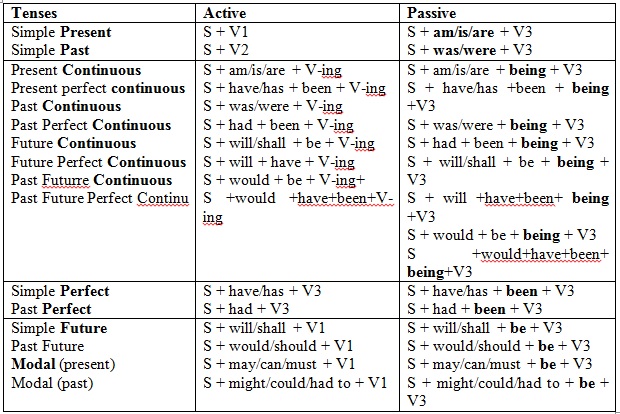
Rumus Pola aktif-pasif untuk semua tenses
1
Jadi lebih singkatnya ciri kalimat pasif/passive voice selain by + O adalah
2
FORM: SUBJECT + BE + THE PAST PARTICIPLE (V3)
Be dalam kalimat pasif menentukan jenis Tense dari kalimat tersebut.
The present tense (am, is , are)
The past tense (was, were)
Infinitive (be)
-ing form (being)
the past participle (been)
Contoh kalimat passive yang menggunakan kata kerja Drive (drive-drove-driven)
1. The simple present tense
Subject + be (am/is/are) + the past participle
(active)                              Someone drives the car everyday
(passive)                           The car is driven everyday
(Passive Question)              Is the car driven everyday?
(Passive Negative)              The car is not driven everyday.
2.  The Simple Past tense
Subject + be (was/were) + the past participle
(active)                              Someone drove the car
(Passive)                           The car was driven
(Passive Question)              was the car driven?
(Passive Negative)              The car was not driven
3.  The simple future tense
Subject + will + be + the past participle
(active)                              Someone will drive the car
(Passive)                           The car will be driven
(Passive question)              Will the car be driven?
(Passive Negative)              The car will not be driven.
4.  The simple future tense
Subject + be (am/is/are) going to + be + the past participle
(active)                              Someone is going to drive the car
(pasiive)                            The car is going to be driven
(Passive question)              Is the car going to be driven?
(Passive Negative)              The car is not going to be driven
5.  The present continuous tense
Subject + be (am/is/are) + being + the past participle
(active)                              Someone is driving the car
(Passive)                           The car is being driven
(Passive question)              Is the car being driven?
(Passive Negative)             The car is not being driven
6. The past continuous tense
Subject + be (was/were) + being + the past participle
(active)                              Someone was driving the car
(Passive)                           The car was being driven
(Passive question)              Was the car being driven?
(Passive Negative)              The car was not being driven
7. The present perfect tense
Subject + has/heve + been + the past participle
(active)                              Someone has driven the car
(Passive)                           The car has been driven
(Passive Question)              Has the car been driven?
(Passive Negative)              The car has not been driven
8. The past perfect tense
Subject + had + been + the past participle
(active)                              Someone had driven the car.
(passive)                           The car had been driven
(passive question)              Had the car been driven?
(passive Negative)             The car had not been driven
9. The future perfect tense
Subject + will have + been + the past participle
(active)                              Someone will have driven the car
(passive)                           The car will have been driven
(Passive question)              Will the car have been driven?
(Passive Negative)              The car will not have been driven
 Perubahan personal pronoun nya adalah sebagai berikut
3
Sumber :
http://aspiandi.blogspot.com/2011/10/tentang-passive-voice.html
http://terkupas.blogspot.com/2012/09/bab-5-passive-voice.html

Passive Voice

1. Passive Voice [Simple Present Tense]
-Pattern = Subject + to be + Verb3
Example :
They buy a book everyday [active]
A book is bought buy them [passive]
2. Passive Voice [Present Continous Tense]
-Pattern = Subject + to be + being + Verb3
Example :
She is drinking a glass of milk [active]
A glass of milk is being drunk by her [passive]
3. Passive Voice [Present Perfect Tense]
-Pattern = Subject + have/has + been + Verb3
Example :
We have done our homework [active]
Our homework have been done by us [passive]
4. Passive Voice [Simple Past Tense]
-Pattern = Subject + to be (was – were) + Verb 2
Example :
I swept the floor yesterday [active]
The florr was swept by me [passive]
5. Passive Voice [Past Continous Tense]
-Pattern = Subject + to be (was – were) + Verb3
Example :
We were typing a letter [active]
A letter was been typed by us [passive]
6. Passie Voice [Past Perfect Tense]
-Pattern = Subject + had + been + Verb3
Example :
He had done his homework [active]
His homework had been done by him [passive]
7. Passie Voice [Simple Future Tense]
-Pattern = Subject + will + be + Verb3
Example :
They will buy a book tomorrow [active]
A book will be bought by them [passive]
8. Passive Voice [Future Continous Tense]
-Pattern = Subject + will be + being + Verb3
Example :
We will be typing a letter [active]
A letter will be being typed by us [passive]
9. Passive Voice [Future Perfect Tense]
-Pattern = Subject + will have + been + Verb3
Example :
He will have done his homework [active]
His homework will have been done by him [passive]

Selasa, 18 Maret 2014


Pengertian Conditional Sentences (Kalimat Pengandaian)
Conditional Sentences (Kalimat Pengandaian) adalah suatu bentuk kalimat majemuk yang dapat kita gunakan ketika kita ingin mengatakan bahwa sesuatu tersebut adalah suatu akibat atau konsekuensi yang tergantung pada situasi lainnya. Di dalamnya terdapat klausa pengandaian (IF CLAUSE) dan klausa akibat (RESULT CLAUSE). Pada bentuk conditional sentences kita menggunakan kata "if (jika)".
Bentuk-bentuk dan Contoh Conditional Sentences:
  1. True in the Present or Future. (Benar pada waktu sekarang dan masa akan datang)
  2. Untrue in the Present or Future. (Tidak benar atau berlawanan dengan kenyataan pada waktu sekarang dan masa akan datang)
  3. Untrue in the Past. (Tidak benar atau berlawanan dengan kenyataan pada masa lalu)
True in the Present or Future (Benar pada waktu sekarang dan masa akan datang)
Bentuk conditional sentences ini digunakan untuk mengekspresikan pengandaian dengan harapan yang dikatakan oleh si pembicara mungkin terjadi untuk masa sekarang ataupun akan datang.
Formula:
Bentuk dari “IF CLAUSE”
(klausa pengandaian)
Bentuk dari “RESULT CLAUSE” (klausa akibat)
Contoh Kalimat
Simple Present Tense
If I have enough money, I buy a new car.
If I have enough money tomorrow, I will buy a new car.
Perhatikan Contoh Kalimat berikut!
IF CLAUSE (Simple Present Tense) – RESULT CLAUSE (Simple Present Tense)
If I don’t eat breakfast, I always get hungry during class.
(Artinya: Jika saya tidak sarapan, saya selalu merasa lapar selama pelajaran di kelas)
Pada contoh kalimat di atas, RESULT CLAUSE menggunakan Simple Present Tense, fungsinya untuk mengekspresikan aktivitas yang sudah menjadi kebiasaan atau situasi.
Makna pada kalimat di atas, si pembicara merasa yakin bahwa dia terbiasa merasa lapar jika dia tidak sarapan sebelum berangkat ke sekolah.
IF CLAUSE (Simple Present Tense) – RESULT CLAUSE (Simple Future Tense)
If I don’t eat breakfast tomorrow, I will get hungry during class.
(Artinya: Jika saya tidak sarapan besok, saya akan merasa lapar selama pelajaran di kelas)
Pada contoh kalimat di atas, RESULT CLAUSE menggunakan Simple Future Tense, fungsinya untuk mengekspresikan bahwa kalimat tersebut menyangkut aktivitas tertentu atau situasi di masa yang akan datang.
Makna pada kalimat di atas, si pembicara mengetahui bahwa dia akan merasa lapar jika besok dia tidak sarapan sebelum berangkat ke sekolah.
CATATAN:
Baik Simple Present Tense ataupun Simple Future digunakan sebagai RESULT CLAUSE (klausa akibat) adalah untuk mengekspresikan suatu ketetapan atau suatu fakta yang dapat diprediksi.
Contoh lain:
If I’m not busy, I come to your party.
If the weather is nice tomorrow, we will go on a picnic.
Untrue in the Present or Future (Tidak benar atau berlawanan dengan kenyataan pada waktu sekarang dan masa akan datang)
Bentuj conditional sentences ini digunakan apabila kita ingin menghayalkan sesuatu keadaan yang bertentangan dengan kenyataan yang ada saat ini dan masa yang akan datang. Dalam hal ini sikap pembicara agak pesimis karena kemungkinan terjadinya perbuatan tersebut hanya sedikit.
Formula:
Bentuk dari “IF CLAUSE”
(klausa pengandaian)
Bentuk dari “RESULT CLAUSE” (klausa akibat)
Contoh Kalimat
Would + VERB 1
If I had enough money, I would buy a new car.
(in truth,  I do not have enough money, so I will not buy a new  car.)
(Kenyataannya, saya tidak punya cukup uang, jadi saya tidak akan membeli mobil baru.)
Perhatikan Contoh Kalimat berikut!
IF CLAUSE (Simple Past Tense) – RESULT CLAUSE (Would + VERB 1)
If I taught this class, I would not give tests.
(Artinya: Jika saya mengajar kelas ini, saya tidak akan memberikan tes)
Makna pada kalimat di atas: kenyataannya, si pembicara tidak mengajar kelas tersebut.
If Sam were here right now, he would help us.
(Artinya: jika Sam ada disini sekarang, dia akan menolong kita)
Makna pada kalimat di atas: kenyataannya, Sam tidak ada disana sekarang.
If I were you, I would accept this invitation.
(Artinya: Jika saya menjadi kamu, saya akan menerima undangan ini)
Makna pada kalimat di atas: kenyataannya, saya bukan kamu.
CATATAN:
Apabila klausa pengandaian (IF CLAUSE) dinyatakan dengan to be, maka yang digunakan adalah “were” untuk semua jenis subject.
Untrue in the Past (Tidak benar atau berlawanan dengan kenyataan pada masa lalu)
Bentuk conditional sentences ini digunakan apabila kita ingin membayangkan suatu kemungkinan lain dari suatu perbuatan atau peristiwa yang telah terjadi dimasa lampau. Atau dapat dikatakan bahwa bentuk ini dapat digunakan untuk menyatakan suatu keadaan atau peristiwa yang berlawanan dengan kenyataan yang sebenarnya dimasa lampau. Sikap pembicara dalam hal ini sangat menyesal terhadap perbuatan yang telah terjadi.
Formula:
Bentuk dari “IF CLAUSE”
(klaus` pengandaian)
Bentuk dari “RESULT CLAUSE” (klausa akibat)
Contoh Kalimat
Past Perfect Tense
Would have + VERB 3
If I had  had enough money, I would have bought a new car yesterday.
(in truth,  I did not have enough money, so I did not buy a new  car yesterday.)
(Kenyataannya, saya tidak punya cukup uang, jadi saya tidak membeli mobil baru kemarin.)
Perhatikan Contoh Kalimat berikut!
IF CLAUSE (Past Perfect Tense) – RESULT CLAUSE ( Woul have + VERB 3)
If they had studied, they would have passed the exam.
(Artinya: jika mereka sudah belajar, mereka akan sudah lulus ujian)
Makna pada kalimat di atas: kenyataannya, mereka tidak belajar sebelumnya, dan mereka gagal atau tidak lulus dalam ujian.
If I had called sarah, she would have come here.
(Artinya: Jika saya sudah menelpon sarah, dia akan sudah datang kesini)
Makna pada kalimat di atas: kenyataannya, saya tidak menelpon sarah sebelumnya, dan sarah tidak datang kesini.
Sumber : http://bahasainggrisonlines.blogspot.com/2013/01/conditional-sentences.html